 |
Most DePIN networks share a structural flaw: they pay contributors with newly minted tokens on a fixed schedule, whether or not anyone is using the network. Supply runs ahead of real demand, operators unplug when the token price falls, and the network spirals down. io.net's Incentive Dynamic Engine (IDE) — live as of June 11, 2026 — is one of the first serious attempts to break that loop. This CoinDesk Research report, commissioned by io.net, examines the IDE's mechanics, its stress-test results, and the conditions under which the model turns net-deflationary. |
|
|
|
Key findings: |
- Fixed emissions are DePIN's original sin: IO launched on a schedule that releases tokens at a fixed pace regardless of network activity — creating structural inflation when demand is low and pushing operators into a "negative spiral" when price falls.
- The IDE pays suppliers in stable dollar terms: Each epoch, the engine calculates the dollar payout owed to all active GPU suppliers and releases only as many IO tokens as needed at the live price — more when cheap, fewer when expensive.
- Surplus gets burned, not distributed: Once supplier payouts are covered, at least 50% of the remaining surplus is used to buy back and permanently destroy IO — targeting retirement of at least 115M of the 231M non-emitted reward pool.
- Stress-tested against a 55% demand drop and a 50% price crash: CryptoEcon Lab's simulations showed supplier income held in both scenarios, with the engine drawing on reserves rather than dumping tokens on the market.
- An $8M enterprise contract is already live: Contributing ~$650K/month in network earnings, with at least 12M $IO projected for burning in year one. The signal to watch: the sustainability ratio holding at or above 1.
|
|
io.net: GPU Compute at 70% Below Cloud Prices |
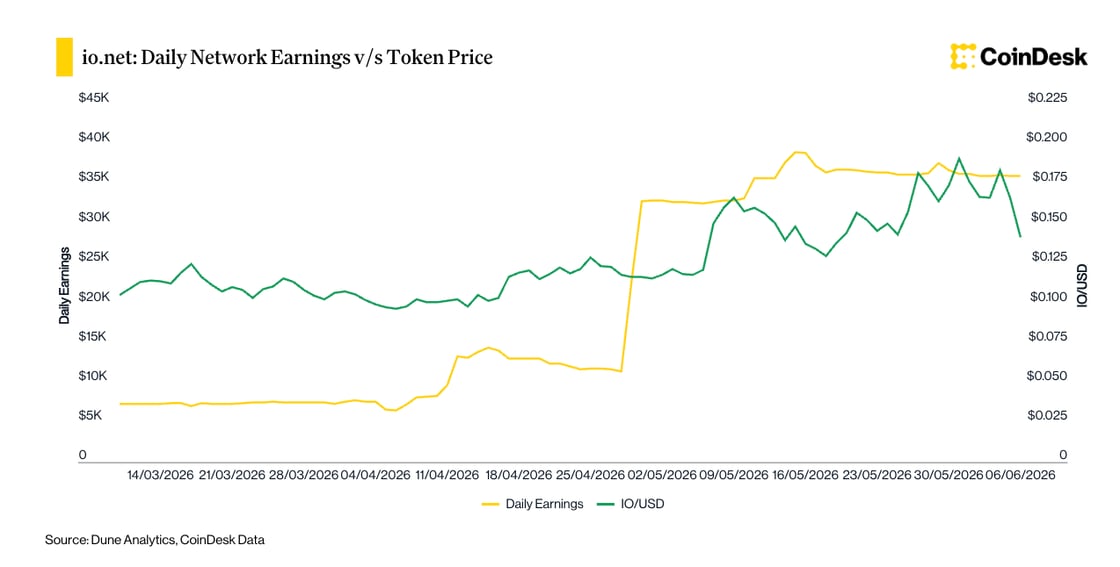
io.net aggregates idle GPU capacity from data centres, miners and independent operators across 138 countries and bundles them on demand into clusters for AI and machine-learning workloads — undercutting AWS on-demand pricing by roughly 70%. Daily network earnings have been trending upward since March 2026, averaging ~$35–36K per day and moving broadly in line with IO's token price. |
 |
|
The Incentive Dynamic Engine: How It Works |
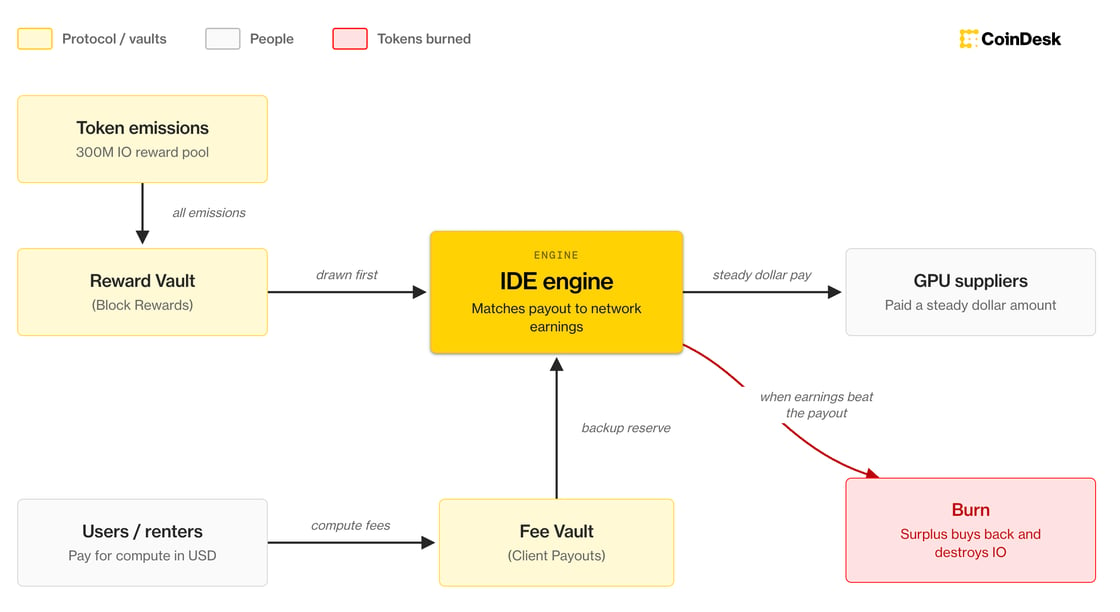
The IDE replaces fixed token emissions with a demand-linked model. Two reserves back the engine: a Reward Vault (Block Rewards), drawn first, and a Fee Vault (Client Payouts), used as backup. When the network earns more than it owes suppliers — a sustainability ratio above 1 — at least half the surplus buys back and permanently destroys IO. The burn mechanism is already active at launch: at a ratio of exactly 1, the engine is already burning at least 50% of block-reward emissions. It turns net-deflationary once the profit margin above a ratio of 1 grows large enough that burning 50% of the combined surplus exceeds the full emission rate. |
 |
|
Stress-Tested: Supplier Income Across Three Scenarios |
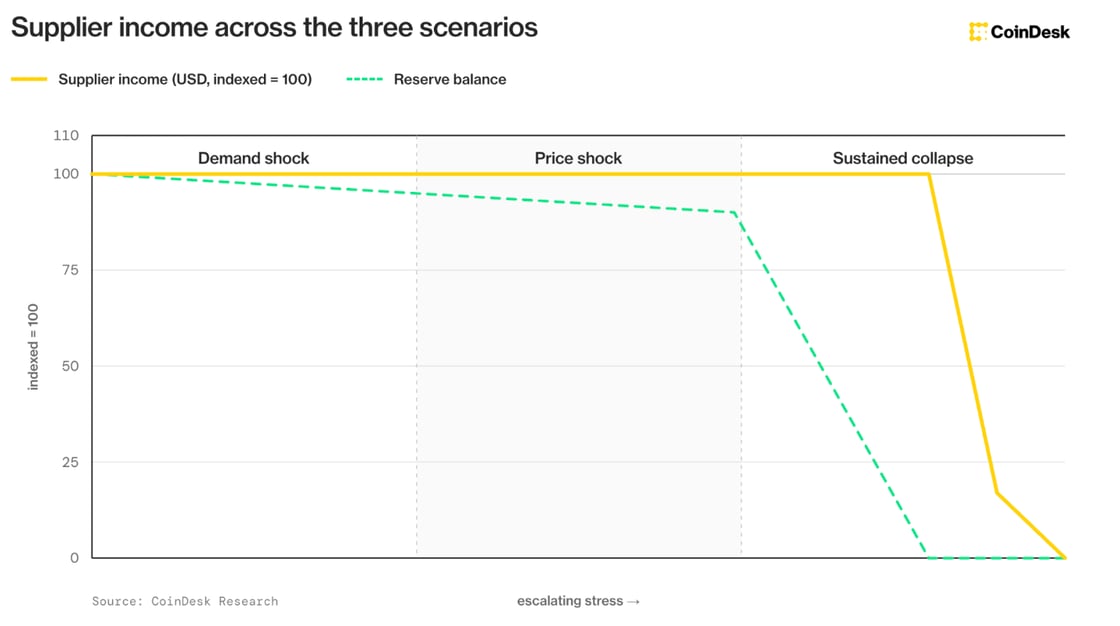
CryptoEcon Lab stress-tested the IDE against a 55% demand drop and a 50% price crash. In both cases, supplier income in dollar terms held — the engine drew on reserves rather than flooding the market with new tokens. In a sustained zero-demand scenario, the system scales down with activity: because compensation is tied to participation rather than fixed commitments, obligations fall alongside the active GPU base, preventing the accumulation of permanent liabilities. |
 |
|
|
This report was commissioned by io.net and produced by CoinDesk Research. It does not constitute any form of investment advice or recommendation. Any redistribution of charts appearing in this report must cite CoinDesk Research as the sole provider and creator. |
|



0 Comments